Published on: Aug 12, 2026
Backpack Exchange Built a Real Retention Mechanic. The On-Chain Data Shows It Still Lost 97% of Its Launch Volume.
Most exchange growth breakdowns are guesswork dressed up as analysis. Someone looks at a referral program and a points system, calls it a “growth loop,” and moves on. No one checks what actually happened on-chain.
Backpack Exchange is a good test case because its full loop played out in public: a multi-season points program, a token launch, and a genuinely unusual retention mechanic. I pulled the on-chain data from TGE through today to see which parts of the loop actually worked.
The loop, as designed
Acquisition ran through points, not just a signup bonus. Users earned points across three products — trading on the exchange, using the Backpack Wallet for Solana activity, and sending payments through Backpack Pay — plus a referral program. The referral rate itself got cut from 30% to 10% in March 2025, a sign the team was tuning acquisition cost down as the program matured.
Activation was volume-weighted. Points scaled with trading volume, liquidity contributions, token holdings, and idle-fund lending, not just account creation. This pushed users from “signed up” to “actually trading” by design.
Retention is where Backpack did something most exchanges don’t: a staking-to-equity mechanism. Users who stake BP for at least a year can convert it into actual company equity, with 20% of shares allocated based on staking duration, amount, and product usage. This isn’t a loyalty discount. It’s a real ownership stake, and it’s the kind of retention lever that should, in theory, keep holders from dumping at the first sign of profit.
The token launched March 23, 2026, at $0.31 (a $3.1B FDV), with a full 25% of supply airdropped to the community and zero allocation held back for insiders. Clean setup. Now the question is what the chain says actually happened.
Finding 1: The acquisition burst was real, and it collapsed fast
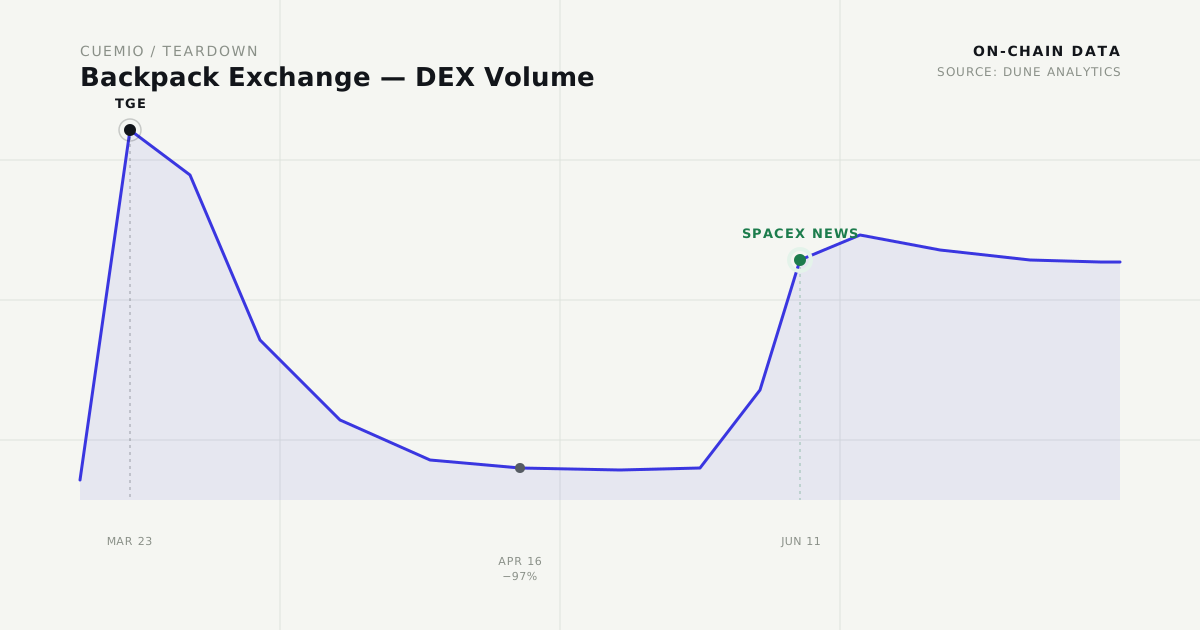
Daily DEX trading volume for BP peaked at $16.98M on March 25, two days after launch, with 74,109 trades on the single busiest day. By April 16, three weeks later, daily volume had fallen to $476K — a 97% drop, with trade count down from ~74K to ~7K a day over the same window.
Holder count tells the same story from a different angle. 1,693 distinct wallets held BP on launch day. By mid-April, that number had fallen to roughly 200 — an 85%+ contraction — while total supply held stayed essentially flat around 235-250M BP the entire time.
That combination only happens one way: the same pool of tokens consolidating into fewer wallets. Not new buyers replacing sellers. The exact same supply, held by fewer and fewer people.
Finding 2: It wasn’t a clean dump to exchanges. It was consolidation.
The obvious assumption is that claimers moved BP straight to a CEX and sold. The top-holder data doesn’t fully support that.
The single largest BP holder today is Backpack’s own exchange hot wallet, sitting on 19.2M BP — roughly 8% of the entire airdrop — back in the platform’s own custody. The second-largest holder isn’t a whale or an exchange at all. It’s a Meteora DLMM liquidity pool (BP-USDC) with $1.86M in TVL and 54 separate LP positions feeding it — meaning a meaningful chunk of “circulating” BP is sitting in on-chain liquidity provision, not idle wallets waiting to be sold.
So the holder collapse wasn’t simply “everyone farmed and dumped.” It was a mix: real consolidation back into Backpack’s own custody, genuine DEX liquidity formation, and active trading. A more layered outcome than the standard airdrop-farming story, and one that’s easy to miss if you only look at price.
Finding 3: The staking-to-equity pitch got its first real stress test in June, and passed
By mid-April, BP’s on-chain volume had bottomed out in the $250K-$450K/day range. Then on June 11, Backpack announced tokenized SpaceX stock through Backpack Securities.
The chain shows the market didn’t react instantly. June 11 itself was an unremarkable $296K trading day. The real move started two days later: June 13 hit $1.16M, June 14 hit $3.6M, and volume stayed elevated in the $1.5M-$4M/day range for two-plus weeks — 5 to 10 times the April trough, and critically, it held rather than spiking and fading the way the TGE volume did.
That’s the difference between hype and a real second demand driver. Backpack’s loop didn’t just survive the airdrop-farmer exit, it found a second acquisition channel that wasn’t dependent on token incentives at all.
What this means if you’re building a growth loop
- A strong retention mechanic doesn’t prevent the initial dump. It just determines what happens after. Nothing about staking-to-equity stopped the 97% volume collapse in the first three weeks. Its value showed up later, in whether the platform had anything left to build on once the mercenary capital cleared out.
- “Holders left” and “holders sold” aren’t the same claim, and on-chain data is the only way to tell them apart. A chunk of Backpack’s “lost” holders were actually the platform reabsorbing supply and users parking BP in DEX liquidity, not necessarily converting to cash.
- A real product catalyst outperforms a points program. The SpaceX news drove sustained volume at levels the points-and-airdrop cycle never held past its first week. If the growth loop only works while you’re paying people to participate, it isn’t a loop yet.
Data pulled from Solana on-chain sources via Dune Analytics. Full queries and dashboard: Backpack Exchange Growth Loop — Dune Dashboard